Skip to content
Buffalo Foundation Repairs

Serving Buffalo and nearby areas

Crumbling Stone Foundation in Buffalo, NY

A crumbling stone foundation in an older Buffalo house usually means the mortar has worn out, and a free inspection shows which parts need repointing, rebuilding or a drain.

Book a free foundation inspection

Tell us what you are seeing. A local specialist calls you back the same business day.

Local to Buffalo

We connect property owners in Buffalo and nearby areas, including North Buffalo, South Buffalo, Elmwood Village, Allentown, Amherst and Cheektowaga, with one independent local foundation repair specialist.

  • Built on local stone

    Buffalo builders used Onondaga limestone from local quarries for foundations, according to the Buffalo Architecture and History dictionary of local building materials.

  • Mostly pre-1940

    About 61 percent of homes in the city were built in 1939 or earlier, when stone and rubble basement walls were common.

  • Fix the water first

    The National Park Service says the cause of mortar decay, such as leaking gutters or settlement, should always be dealt with before repointing.

What it costs

Typical published ranges for Buffalo. The contractor's written estimate is the price, and the inspection is free.

WorkTypical range
Inspection and written estimate Free
Repointing mortar joints $3 to $15per sq ft
Tuckpointing with finished joints $5 to $25per sq ft
Interior drain $40 to $120per linear foot
Interior waterproofing, whole job $2,000 to $6,000
Foundation repair, typical job $2,200 to $8,200

See typical foundation repair prices in Buffalo

What a crumbling stone foundation looks like

Many older Buffalo houses sit on walls of stacked stone held together with mortar. When that mortar fails, you see it.

Sand on the floor

A line of grit and sand collects along the bottom of the wall. That is mortar falling out of the joints.

Deep, empty joints

You can push a finger or a screwdriver into the gaps between stones.

Loose stones

A stone wiggles when you push it, or one has fallen out.

A bulge

Part of the wall leans in or has a belly in the middle.

Damp patches and white crust

Some spots stay wet, and a white salt crust forms on the stone and mortar.

Peeling coating

Old paint or a cement coat flakes off in sheets.

Why stone foundations crumble in Buffalo

They are old

About 61 percent of homes in Buffalo were built in 1939 or earlier. Local builders used Onondaga limestone, a stone that runs from the Hudson Valley west to Buffalo, along with field stone and rubble. The stone itself is tough. The mortar between the stones is the weak link, and much of it is close to a century old.

Water carries the mortar away

Older mortar was soft and full of lime. Each time water passes through a joint, it carries a little of that lime away. Leaking gutters, short downspouts and soil that slopes toward the house speed this up. The National Park Service shows a wall where a leaking downspout washed most of the mortar out of the joints.

Frost works the joints open

NOAA data for Buffalo counts about 53 freeze-thaw cycles in an average year, with a 50-year frost depth of 59 inches. Water in a joint freezes and expands, then thaws. Over decades this pries the joint open and loosens the stones.

The wrong patch

Hard cement mortar or a sealed coating from an old repair can make things worse. The National Park Service says new mortar should be softer and more breathable than the stone. Hard mortar forces water to leave through the stone instead, and the stone faces start to flake.

Cosmetic or urgent

Cosmetic

A little sand on the floor and shallow joints, with a dry wall. Plan to repoint, and fix the gutters now.

Plan a fix soon

Deep joints over large areas, damp walls, or loose stones in a few spots. Water is getting in and the wall is losing strength.

Call now

A bulge, stones falling out, a wall that has shifted under a post or beam, or cracks upstairs that showed up at the same time.

How it usually gets fixed

  1. Fix the water first. Gutters, downspouts and grading. The National Park Service says the cause of mortar decay should always be dealt with before repointing.
  2. Repoint. The crew rakes out the loose mortar to a sound depth and packs in new mortar matched to the old wall. A soft, lime-based mix lets the wall breathe.
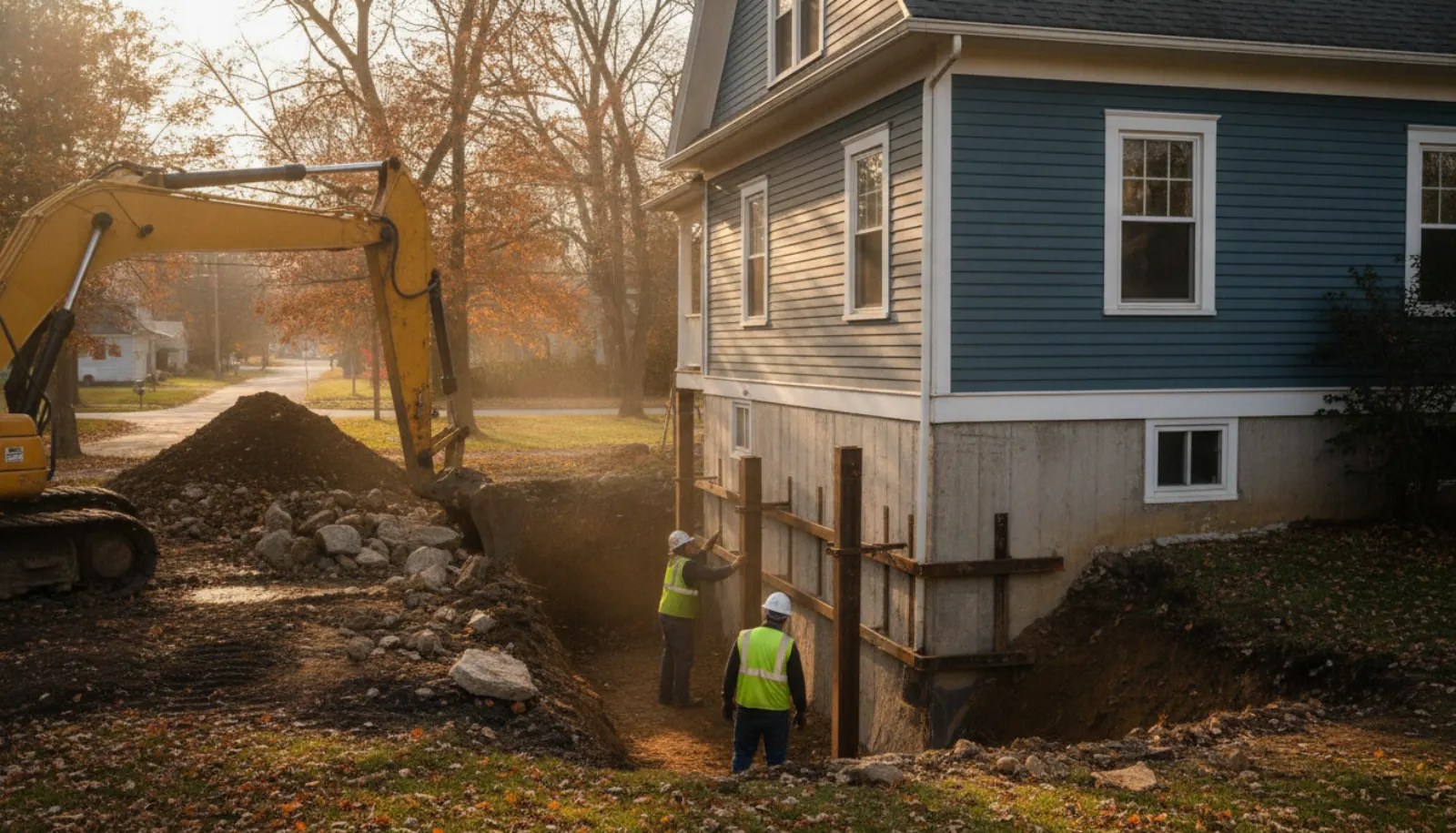
  3. Rebuild bad sections. Where stones are loose or the wall bulges, the crew may brace the house, take that section apart and relay it, sometimes with new block or concrete.
  4. Add an inside drain. Stone walls pass some water by nature. A drain at the floor and a sump pump catch it before it spreads.

Repointing is priced by the square foot of wall. The ranges below are typical ranges from national cost guides. Your written estimate gives the real number.

Questions to ask the crew

  • What mortar will you use, and is it softer than the stone?
  • How deep will you rake out the old joints?
  • Which sections need rebuilding, and which only need repointing?
  • Where is the water coming from, and does the price include fixing it?
  • What does the warranty cover on repointed and rebuilt sections?

Before the inspection

  • Sweep the sand along the wall and see how fast it comes back.
  • Note any spots that are damp, and when.
  • Do not pull out loose stones or chip at a bulge.
  • Do not paint or seal the wall before it is inspected.
  • Point downspouts away from the house.
  • Look for cracks upstairs above the worst part of the wall.

Frequently asked questions

Is an old stone foundation bad?

No. Many Buffalo stone foundations have stood for over 100 years. The stones last. It is the mortar between them that wears out and needs to be redone every few decades.

Can I repoint my stone basement myself?

Small spots, yes, if you rake out only the loose mortar and use a soft lime-based mix. Large areas, bulging sections or walls that leak are better left to a mason or foundation crew.

Why not use regular cement mortar?

The National Park Service says new mortar should be softer and more breathable than the stone. Hard cement mortar can trap water and push the damage into the stone itself.

Should I parge or coat the stone wall?

A thin coat can tidy up the look, but a coat that seals the wall can trap water and peel off. Fix the water source and the mortar first, then decide on a finish.

Can a stone foundation be waterproofed?

Usually from the inside with a drain along the floor and a sump pump. Stone walls let some water through by nature, so the goal is to catch it and pump it out.

(716) 621-3279 Free inspection